Why Most Workplace Meetings Suck

Summary: Let's be honest: most workplace meetings are a waste of time. We all know it, yet we keep scheduling them. The good news? It doesn't have to be this way. In this article, I'm going to break down exactly why your workplace meetings probably aren't working, what the research tells us about ineffective meetings, and most importantly, give you practical strategies to transform your meeting culture. Whether you're drowning in back-to-back calls or simply frustrated by meetings that go nowhere, this guide will help you create meetings that actually matter.
Workplace Meetings are Not the Problem
So if I say the word meeting, what comes to mind? Chances are if you are like most people, whatever you imagined probably had a negative connotation. In fact, there is such a stigma around the modern-day workplace meetings that they have become an endless supply of material for memes, TV shows, and comedians. I think this picture sums it up well:
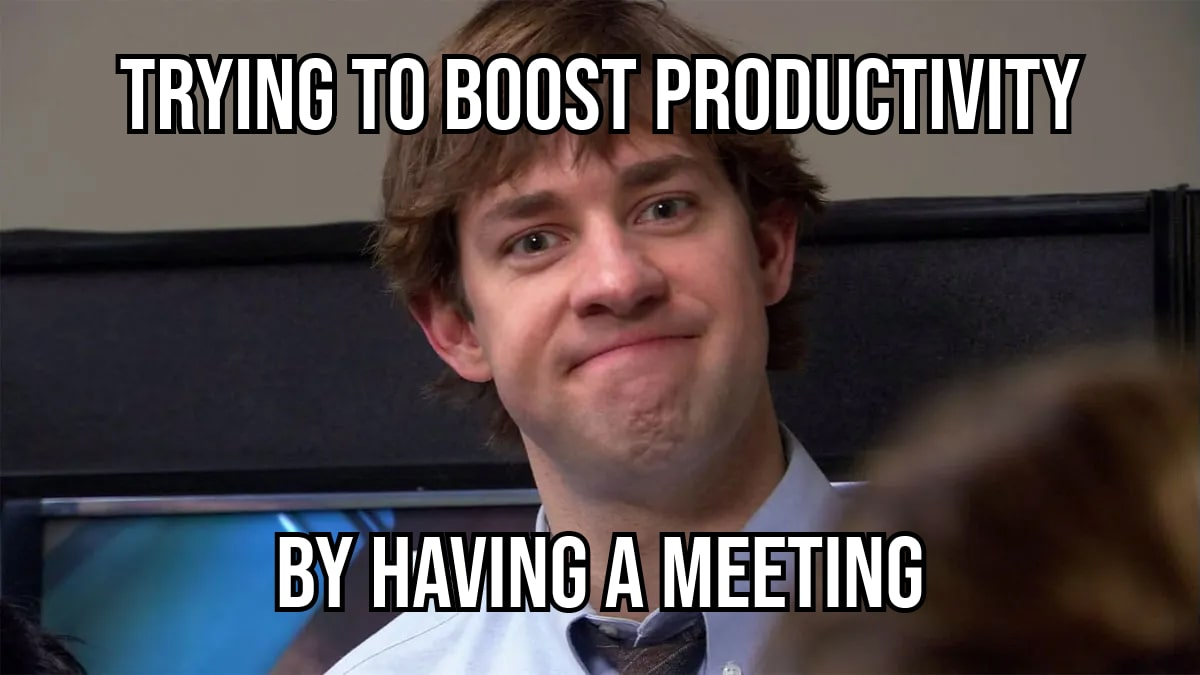
However, despite the many critiques surrounding workplace meetings, many people still see them as valuable. A 2024 study by Calendly showed that 68% of workers believe meetings are essential for progress on team projects. So how did we get here?
When we take a closer look, the answer starts to become a little more clear:
A study by Acuity showed that in 2022, people wasted (on average) 91 minutes per day on tasks and meetings that weren't important to their role.
Research by Atlassian found that meetings are ineffective 72% of the time. The same study showed that 77% of workers say that they frequently attend meetings that end in a decision to schedule another meeting.
Microsoft found that the average worker spends 57% of their time communicating in meetings, email, and chat.
It would appear that it is not workplace meetings themselves that are the problem. Rather, it is the sheer amount of meetings and their ineffectiveness which has led to widespread skepticism amongst workers. When you begin to dive into the research, the evidence is staggering. Most workplace meetings suck!
What Makes Workplace Meetings Ineffective?
So we have examined what people think of meetings and the impact poorly executed workplace meetings have on workers. However, what exactly makes a meeting bad? There are a number of different reasons, but here are some of the most common I have observed:
1. Lack of Clarity
The truth is for many workplace meetings, most people on your team probably don't know what they are about or why they have to be there. This stems from two problems:
There was never a clear vision cast for the purpose of this particular meeting.
There is no agenda with clear and specific items.
Often as leaders, we forget what we know. We assume that certain things are evident to others on the team. Yet the only reason they are clear to us is that we have access to certain information as leaders that give us the full picture. Thus many leaders under-communicate. The truth is, yes, you do have to spell it out for your team.
If you can't articulate the purpose and value of a certain meeting in 1-2 sentences, then your message is not clear enough. Furthermore, you need to make sure you have a detailed agenda that goes out to everyone present at the meeting beforehand. This will greatly increase people's buy-in and also help with our next point.
2. Meetings Going Overtime
Another big reason why many people hate workplace meetings is that they frequently go over time. A big part of this is because usually we have not covered the previous point. If meetings have a clear purpose and agenda, they are less likely to go off on unrelated tangents. For example, what was supposed to be a simple update meeting turns into a brainstorming session.
I understand that we can't be perfect and sometimes running late will be inevitable. However, the more often you do this, the more you risk frustrating your team and having them check out early because they are getting stressed and have to get back to work (or the next meeting they probably didn't need to be at).
3. No Follow-Through
One stat I shared earlier which illustrates this problem well is that 77% of meetings end in a decision to have another meeting. Ultimately, people lose faith because they feel like all they do is talk, and there is no action. Sometimes another meeting may in fact be needed. However, just like going overtime, this happens far too often.
I have observed that this usually stems from limitations of the leader like perfectionism, people-pleasing, or a lack of urgency. You can't always have the "right" answer or make everyone happy. Sometimes a leader needs to commit ahead of time to deciding on a course of action. Then communicate that urgency to the team at the beginning of the meeting so they have the same sense of urgency.
Secondly, the other big reason workplace meetings don't have follow-up is that there is no effective way of capturing and circulating insights from the meeting. Lucky for us, there is a variety of tools available today to help with this, from shared documents to AI notetakers. The key is to have a system in place that accurately captures major takeaways and action points, and then preferably can automate reminders to enforce follow-up on action items.
4. Missing the Big Picture
This goes hand-in-hand with clarity, but leaders need to help their team connect mundane and routine tasks to a greater sense of purpose. Insights from Google's Project Aristotle demonstrated that teams perform much higher when they feel their work makes meaningful contributions to the organization.
Once again, a leader will more easily be able to see the big picture, but to many people on your team, some of the tasks they do will appear as mere compliance or busy work. Leaders need to cast a vision to help them see how the small things add up to a bigger picture.
How to Transform Your Meetings

If those were some of the common reasons why workplace meetings suck, in this next section I want to provide a few strategies to help you reset your meeting dynamics for greater effectiveness. Here are some great steps to rewire your system for meetings:
1. Conduct a Time Audit with Your Team
Have you and your team go through their calendars and find the average time per week they spend on workplace meetings. Use these numbers to create an overall average for your organization. What does this number tell you? Are you happy with it? Does it truly allow your team to perform at their highest and balance the many other demands of their job?
Chances are, the number will be too high. If so, I would encourage you to set a goal to lower that number. This is somewhat arbitrary, but I would recommend no more than one-third of an average work week should be spent in meetings.
Of course, then there is always the fear: "What if we need more meetings?" To that I would say, "What's at risk to try fewer meetings? What's at risk not to?" Chances are there are valuable hours of productive work being left on the table that your team can't access because of meetings. As we have unpacked, most workplace meetings are not effective anyways, and for many leaders, having extra meetings is really a placebo that gives them the illusion of being more productive or in control.
2. Improve Your Communication Channels
I explore the concept of communication channels in another blog post I wrote here. Your communication channels are the various tools and methods you use for communication in your organization. This can include email, Slack, town hall meetings, memo boards, etc.
Most organizations use too many. The key is to try and reduce this number down to 3-5 channels that everyone in the organization is aware of and committed to using. You can also define which channels are used for certain purposes. For example, email is used for anything that must be communicated in writing and you can expect a response within 24-48 hours.
This is important because if you are going to reduce the number of workplace meetings you have, you need to make sure there is a system in place that empowers your team to get the answers they need quickly. If you set up a proper communication system, it will make it much easier to reduce the number of meetings you have.
3. Assign Meeting Roles
Finally, it can be very helpful to assign specific meeting roles to each person on your team. Typically, the only role we think of is a notetaker. However, you could try something like a mediator who steps in when disagreements or interruptions happen. You could have someone who makes sure the meeting stays on topic and on time. You could even have an idea person whose job it is to expand upon ideas others have said.
You can also experiment with rotating these roles during workplace meetings so everyone can wear different hats at different times. This takes some pressure off the leader for having to account for every aspect of the meeting, which can be difficult. It also gives the team shared responsibility over the meeting, which will help increase engagement and buy-in.
A Workplace that Works for Your Team
Workplace meetings don't have to suck. Most leaders have simply never considered the value of being more intentional with their system for meetings. Just making a few of these small shifts you learned today will make a significant difference in the engagement and productivity of your team.
However, sometimes it's helpful to have some support along the way. If you would like some help in implementing organizational change, such as your meeting structure, I help leaders achieve this through 1:1 leadership coaching. By providing a third-party perspective and accountability, I help leaders identify their blind spots and stay committed to the things that truly matter to them. All the while, I provide time-tested leadership tools and strategies to increase your confidence to lead.
If you are interested, go ahead and book a Free 30-Minute Discovery Call to get the process started!
Key Takeaways:
68% of workers believe meetings are essential for progress on team projects
72% of meetings are ineffective
91 minutes per day are wasted on unimportant meetings and tasks
Lack of clarity, going overtime, and no follow-through are the main problems
Conducting time audits, improving communication channels, and assigning meeting roles can transform your meeting culture
Related Articles: