
Summary: Ever feel like you're constantly busy but not actually getting anywhere? You're not alone. Most of us confuse activity with achievement, filling our days with tasks that keep us occupied but don't move the needle on what really matters. Here's the thing: true productivity isn't about cramming more into your schedule or working longer hours. It's about working smarter by managing your focus, protecting your energy, and sharpening your judgment about what deserves your attention. In this article, I'll break down the three pillars of an effective time management system and give you practical strategies you can start using today to reclaim control of your workday.
The Time Management Paradox: Doing Less to Achieve More
I like to joke around and say that the most productive people tend to also be the laziest. In reality, we know that is not the case, but there is a hint of truth in it. Paradoxically, I have observed that many hyper-productive people do not work the most hours and often maintain a relaxed pace throughout the day. This is because the most productive people have usually become incredibly proficient at not doing any more work than is absolutely necessary. Thus, they are relentless in prioritizing only the most important and impactful tasks and eliminating everything else. Tim Ferriss breaks this and other productivity insights down in this video.
Ferriss is a big proponent that the most productive people do not do the most things, but the right things. I think it's important to mention this concept first because many people start from a false premise when it comes to productivity or "time management."
I'm not really a fan of the term time management because it leads us in the wrong direction. See, no matter what you do, you will still have the same amount of time available to you each day. You will still have the same amount of time available each day as everyone else does too (crazy I know). Rather, what prevents us from maximizing that time is our focus, energy, and judgment. Do we know how to use these things effectively? So really, we are not trying to manage our time, but lead ourselves well.
You can give two people an hour to complete a task, and they will both use it in very different ways and produce very different kinds of work. Thus, whenever I'm helping leaders improve their time management system, I encourage them to make the mental shift away from focusing on maximizing time to maximizing their focus, energy, and judgment. How are you showing up to work each day?
So for the rest of the article I want to unpack each element I mentioned in more detail and also give you some tools and strategies for each so you can build out a high-performing time management system.
Pillar 1: Managing Your Focus in a Distracted World

Let's start with what I would argue is the most important piece of the puzzle: focus. Perhaps this wasn't always the most important factor, but today it has taken front and center stage. Technology and a world characterized by constant stimulation means people have more trouble focusing than ever before. This has a profound impact on our productivity.
We typically see the occasional glance at the phone or pausing to make an Amazon purchase as harmless. Yet research has shown that every time we change tasks or get distracted, it can take up to 23 minutes for our brain to return to the original task. Think of it like slamming on the brakes in the middle of the highway. Yes, you can start immediately driving again, but it will take a while to get back up to highway speed. If we multiply an instance like this three, five, ten, or even more times a day (like when we check our email multiple times), that can easily add up to hours of productive time lost in a day. Things like phone addiction and multitasking drastically increase our chances of getting interrupted and are costing you a significant amount of time.
This is why I say that attention management is far more important than time management. So what can we do about this? A couple of simple strategies to immediately improve your focus include:
1. Turn Your Smart Phone into a Dumb Phone
While our phones are incredibly useful, many of the apps and functions on them are designed to be addictive. Thus, it can really help to adjust the settings on your phone to disincentivize you from constantly checking it. Most smartphones today contain numerous options to do this. Here are a few of my favorites:
Turn the colors of your phone to grayscale during the day
Turn off all notifications except the ones you absolutely need
Create scheduled focus-time blocks during the day where you can't access certain apps
2. Time Block Your Most Important Tasks
This is where you take your most important tasks for the day and schedule specific blocks of time during the day to work on them. The key is to treat these times like a non-negotiable meeting with yourself. Thus, you are not checking your email or jumping between other tasks. Giving yourself permission to focus on one thing at a time will greatly improve the efficiency of your work and prevent distraction. I recommend not scheduling longer than 90-minute blocks before taking a break (more on that to come).
Pillar 2: Protecting Your Energy Throughout the Day
The next pillar of your time management system to address is your energy. Since many of us today are knowledge workers and the majority of our work is not physical but mental, we often downplay the importance of managing our energy. Historically, the mentality has usually been to simply push through fatigue, and things like losing sleep, skipping lunch, and not taking breaks are seen as a badge of honor. However, let's think about this for a second.
A car going 100 km/hour for five hours will travel farther than a car going 60 km/hour for eight hours. Your brain requires energy and rest the same way your muscles do. Yet cognitive fatigue is sometimes harder for us to notice than physical fatigue. Nonetheless, it has a significant impact on our output. Thus, if we want to perform at a high level, we need to recover at a high level as well. This is something athletes have always understood. Furthermore, we will not only get more work done this way, the quality of our work will also drastically improve.
So here are a couple of strategies to better manage your energy throughout the day:
1. Take More Breaks
If you start to experience brain fog or drowsiness, more coffee is often not the answer. We experience biological rhythms throughout the day that impact many things, including the processing power of our brain. This usually looks like peaking somewhere around 60 to 90 minutes into work before taking a dip and then recovering. This goes back to what I mentioned earlier where it's best not to work for longer than 90 minutes at a time before taking a short break. Get away from your desk, move around, or talk to a coworker. Once you return to your desk, you will notice that you can enter into a focused state of work much faster.
2. Protect Your Green Zones
We often assume all hours are created equal, but every person has different peaks and troughs of energy throughout the day. Some people are more productive in the morning, others in the afternoon. I like to encourage clients to divide their day into different zones. The key is to find what time of day you are often at your most awake and alert. This is your Green Zone. Then time block your most challenging tasks during this time. Also try to really protect this time and not allow distractions. This could look like turning off your phone or closing your office door. Whatever helps you make the most of your peak energy hours.
Pillar 3: Sharpening Your Judgment and Prioritization Skills
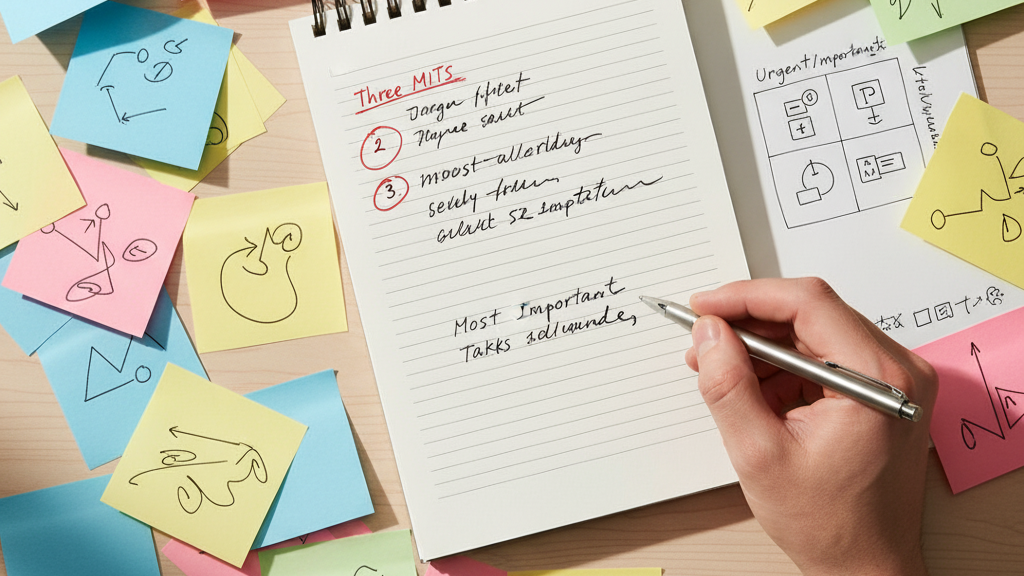
The final piece to your time management system is judgment. By judgment, I mean how well you judge the impact of your work and prioritize accordingly. As I mentioned earlier, productivity is not so much about doing many things, but doing the right things. This is a difficult area for people to master because we rarely take time to reflect on what is truly working for us and what is not. This is one of the values of coaching, as I can come in and provide a third-party perspective and help identify where blind spots or assumptions may be.
One question I love to encourage clients to ask is: "What are the things I think are productive that are actually not? And what are the things I think are not productive that really are?" Often we get so busy that many of the decisions we make in prioritizing our work are done from an emotional level. Instead of what will create the most impact, our brain defaults to what will bring me the most peace and satisfaction? This is where developing self-awareness becomes crucial for making better choices about how we spend our time.
Here are some practical tips to help you grow in this area:
1. Use a Simple Framework
Having some kind of framework can take a lot of the guesswork out of prioritization and help you visualize your progress. There are many tools out there, and I'm not here to advocate for one or the other. The key is that the tool is simple and something you feel you can commit to using. That being said, a couple that I like are the Eisenhower Matrix or the 4D Model.
2. Decide on Your 3 MITs
This can be done in tandem with time blocking, and it is essentially taking time at the end of the work day to decide what your three Most Important Tasks will be for the next day. Give yourself some space to really reflect on what will make the most impact and why. Then time block it, preferably in your green zone. Also consider how much time you think you need to complete the task or make progress on it. Having this intentional space to reflect will improve your ability to judge the value of a given project and how much time it will need. Over time, this will help you develop your ability to prioritize work.
BONUS: Hire a Coach
Like I said, having a third-party perspective can be very valuable for this kind of work. A leadership coach will help you develop awareness around how your habits and beliefs affect your work behaviors. Furthermore, a coach can provide needed accountability in the process of changing those behaviors so you can achieve your personal and professional goals. If you are curious to learn more about how I can help you build out your time management system, go ahead and book a Free Discovery Call.
Ready to Transform Your System?
So there you have it. All the pieces you need to start rewiring your time management system and accomplishing more. If this sounds like an area you or your team could use help in, I offer a specific coaching package to address this very issue called my High Impact Performance Track.
Throughout this program, you will be equipped to:
Develop self-awareness to align your habits with professional goals
Optimize your workspace for improved focus and efficiency
Learn proven tools and strategies to master prioritization and time management
Establish boundaries and overcome perfectionism to protect your time
Build sustainable high-performance habits to maintain long-term productivity
Go ahead and book a Free Discovery Call with me to get the process started!